7/5/07

Say Hai to Japanese Television
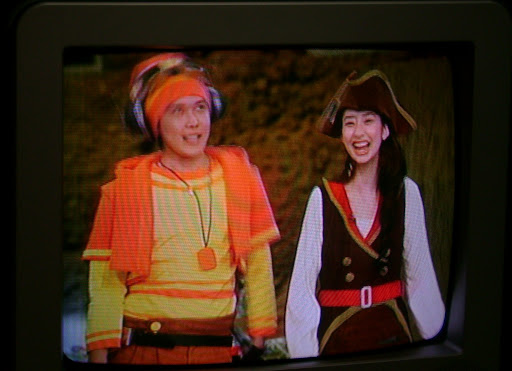

So, we get back from another exhausting day of running around Tokyo and turn on the TV. Baseball game is on -- perfect. It's a late inning, and the Hokkaido Nipponham Fighters are locked in an epic struggle with the Tokyo Yomiuri Giants. The Giants are at bat, and the pressure is visibly getting to the Fighters' pitcher: His team is down and the Giants have runners on base. He's definitely American and he's definitely not getting the calls he wants from the umpire. He's on the mound cursing a blue streak in English (lots of "Fork!" and "Schmidt!" and "Mother Trucker!").

A conference gathers at the mound (as I recall, the manager is American, too). The cursing gets so bad that one of the pitcher's Japanese teammates puts a glove in front of the pitcher's mouth: Maybe he figured even a Japanese audience with no help from the sound could understand the filth coming out of this guy's mouth. Eventually he's replaced, and the Fighters get out of the inning and begin to try mounting a comeback. All of a sudden, they cut away to another program!

A programming note had indicated that another program would come on at the top of the hour. (Laura's memory is more charitable than mine: She remembers them breaking in with the news. I remember it as the Japanese equivalent to The Fresh Prince of Bel-Air. It was one or the other.) But I assumed that, as on American television, if the game ran long, then they would " ... join our regularly scheduled program, already in progress." This assumption is so ingrained I would never have thought to question it. The Japanese are having none of it. Time for the next show. Moving on.

(OK, so maybe the struggle wasn't so epic. The Giants were up by a few runs and, from what I could tell, this was a largely meaningless regular season game. And they probably warned everyone a million times, in Japanese, that they would be cutting away. Still, as the man once said, "I need closure!")

That was the most frustrating thing that happened watching Japanese TV. And there was plenty of the crazy stuff you'd expect (pictured above). Then there was one show that I got completely addicted to.

While on a post-baseball binge of like four episodes in a row(!), I wrote an URL down after it appeared on screen: www.tv-tokyo.co.jp/inaka. (I've got to warn you -- I don't know if this is the URL of the show I was actually watching. And also that link is in Japanese -- here's the Google translation: http://tinyurl.com/3aw328.) Because of production values and a dearth of commercials, I got the idea it was public TV, but I don't even know that. In fact, I have no idea what I was watching at all. But here's hoping the following capsule of one episode is half as entertaining as actually watching--

A well-dressed guy addresses the camera before taking a journey on boat. (Is this symbolism? How big is Japan? Don't they have bullet trains?) He is going to an obscure part of Japan. (I know this because they show a map with a star at the starting point and the destination.) Guy gets off the boat and asks a stranger for directions. Guy wanders around, seemingly aimlessly, addressing the camera occasionally. Guy finds the big, nice house he's been searching for (it's now dark outside) and rings the bell. Guy asks the woman at the door a serious of questions. The answer is always "hai" [yes] until the situation becomes somewhat clear to her and she asks the man in. (Laura remembers an epiphany; I remember her getting tired of standing at the open door talking to a man she doesn't apparently know.)

Woman lives with her husband and son, who are also home. Guy and Husband sit down to chat. Son (who is wearing what appears to be a Japanese doo rag) drags a futon out of a closet and begins preparing the guest room. Woman prepares, like, a nine course meal, which they all eat. Guy goes to bed. In the morning, everyone chats. Son has thankfully taken off the doo rag, and Husband has a maudlin moment in which he almost cries. They all pile into a van to take Guy back to the boat. Boat takes off, and Guy and family wave to each other for, like, five minutes. Seriously. So much waving. Guy turns maudlin himself and also calls out "arrigato!" [thank you] many, many times. End of show.

7/1/07

A Red Sox Fan in Hawaii and Japan

art

Like a lot of people, I feel a certain pride by proxy when those with something in common with me do well. I'm often interested in the success of members of my family, people from my hometown, my fellow alumni, and even alumni at the school where I'm employed. And as Red Sox fans, Laura and I are often interested in the success of our favorite former Red Sox. Assuming they're not actually playing the Red Sox, we'll cheer for Kevin Millar, now of the Orioles, or Orlando Cabrera, now of the Angels. (Sorry Trot -- we couldn't possibly root for Cleveland unless y'all got rid of that Indian-equivalent-to-blackface mascot.)

By the time we were leaving for Tokyo, Honolulu had begun to feel like a hometown, so I was becoming interested in the success of Hawaiians. In the airport, as we were going to our gate, I noticed a display about Wally Yonamine, a Hawaiian who had played baseball in Japan.

As it turns out, our Homeikan was just down the street from the Tokyo Dome, where the Tokyo Yomiuri Giants, Yonamine's former team, plays. The first night we were in Toyko, we went exploring and found a mall right next to the Dome. At the mall, you can't hear a peep from the Dome, so we had no clue that a game was actually in progress until we got back to our room and turned on the TV. All the more amazing because at Japanese baseball games, like at soccer games around the world, there's a lot of chanting. (We had actually heard some of the game on the radio at dinner, but we thought the cooks and patrons at this particular Ramen joint -- all men, and none terribly happy to see us -- were listening to a soccer game. We recognized the commentators' voices from the radio once we saw the game on TV.)

After watching part of two games on TV and having stayed down the street from the Dome, I was just about ready to make the Giants my Japanese team. Then suspicion sunk in: This is Tokyo or, as a good friend calls it, New York, Japan. It's a huge city with a lot of influence and money, and it could probably afford to have a great team at any cost. Any Red Sox fan already knows what I'm driving at: What if the Giants are the Japanese Yankees?

This possibility was only reinforced by the fact that the Giants were the team of Godzilla (Hidekei Matsui, whose face is all over the Tokyo subway) before he went to the Yankees. Despite my sentimental feelings toward Hawaii and Tokyo and my formative experiences of Japanese baseball, I had to guard myself against this possibility. A Red Sox fan -- being defined almost as much by a dislike for the Yankees as by an affection for the Sox -- could never be a fan of a team that smells even a little bit like the Yankees.

A quick visit to Wikipedia has confirmed my suspicion: "They are regarded as "The New York Yankees of Japan" due to their past dominance of the league". Sorry, Giants -- you'll never be my team.

By the way, that proprietary feeling is clearly at work in Japan: Because of Dice-K, the press reports on the Red Sox, at least when Dice-K is playing, almost as though it were a Japanese team. If only that feeling worked in reverse: Then I would support the Seibu Lions, Dice-K's former team, hands down.

6/29/07

Tokyo Drifters


This is a picture of the Senso-ji Temple in the Asakusa district (click on the picture to make it very big). Note the gaggle of schoolchildren in the foreground; Senso-ji is to Tokyo as the Statue of Liberty is to New York City. Tourism central, only with way, way more souvenirs, if you can believe it. The shopping street leading up to the main gate has been around for a few centuries, and feels a little bit like the Taste of Chicago in its crowded frenzy.

The temple was originally built in 645 AD although, like most of Tokyo, we bombed the hell out of it during WWII and it was rebuilt in the 1950s. Purely by accident, Charlie and I entered through the calmer, back entrance and checked out a cool samurai statue.

Continuing forward to the massive temple, we watched people throw money into a wide, well-like thing lined with metal designed, I think, to magnify the sound of the coins falling in. Then the people prayed. The temple has a huge lantern and a cloud of burning incense in front of it as you face its equally massive gate. To the west of the temple is a five-story pagoda dedicated to the people of Asakusa. Directly to the east lies what we believe to be the cleanest public restroom we have ever seen in our lives, despite the fact that possibly fifty thousand people use it per minute.

We read in our guidebook that Asakusa is also called "shitamachi" (no snickering) or "the low city" because it's an older part of town with less development. Gangsters supposedly hang out here, although we saw no signs of this. We did see lots of energy drinks with funny names sold from vending machines all over the place. We also watched a men's lacrosse match at nearby Tokyo University. No signs exotic dancers or other forms of vice. What is wrong with Tokyo? Why must everything be so well-run and orderly? We consoled ourselves with fun candy at the Ueno train station.

We spent the next day, when it rained, in Ueno Park at the Tokyo National Museum (actually four museums for the price of one). We liked the swords, and the kimonos, and the ancient ceramics, and the scroll paintings, but the coolest thing was a smiling Buddha head from China. Our gifts for our parents come courtesy of the gift shop here. We loved buying stuff in Tokyo -- your bill is presented to you on a little tray (even for a few souvenirs) and when you've finished paying your credit card is handed back to you with a deep and formal bow. In this city, bowing happens a lot.

We saw many homeless people in Ueno Park. Or perhaps they were merely drunk -- we walked through the park on both Saturday and Sunday morning. They were all men, some sleeping on park benches, but some sprawled out right on the pavement as if they'd been shot. I was a little worried about the first guy we passed, but soon became accustomed to the sight. They all had taken off their shoes and lined them up neatly together somewhere near their passed-out bodies. We also saw a long line for Second Harvest ("America's" dropped) right in front of the museums, about 100-200 men waiting for a cup of soup. We didn't see any destitute women in the park, or anywhere else in public. I wonder what that's about.

Tokyo is like Rome in that homeless cats seem have free reign in the parks. The cats don't beg; they seem pretty indifferent to people in general. They must be well-fed. Eating was something we did pretty haphazardly while in Tokyo; we were just always on the move. Partly, too, we were afraid to order, at least at first. But most places had menus with pictures that we could point to. We particularly liked to have a serene cup of coffee (for Charlie) and cocoa (for Laura) at a cafe down the street from our ryokan.

Our nerves fried after running the shopping gauntlet in front of the Senso-ji Temple, we stopped for soba noodles in a traditional restaurant. We were seated next to a family: grandfather, mother and grandaughter, all expertly lifting their noodles high into the air, dipping them in sauce, and then slurping them down in one fluid motion. We must have looked like cavemen in comparison. But we did learn one phrase, itadakimas, "I will receive," which you say when your food is served. I think the Japanese must have had low expectations for us gaigin (foreigners), because they always looked so surprised and happy when we actually observed this little formality.

Our best eating experience by far came at the ryokan, where each morning we were served a seven-dish breakfast with rice and tea in our room. We loved our maid, who brought in the trays stacked from her knees to her shoulders. Keeping up a constant stream of Japanese, completely unintelligible to us, she smiled as she pointed out the dishes and set out bowls for the rice and cups for the tea. This old lady could have been cursing the idiot gaigin for all we knew, but she certainly seemed sweet and well-meaning. All we could do was keep arrigato-ing and hoping that thank you was enough.

6/28/07

Talk about the weather

Today was one of these days that starts out warm. It's almost July, so you automatically put on a short-sleeve shirt. And then, by the end of the day, it's cold outside, so cold you look around your desk and wonder if you can make a jacket out of printer paper. Something, anything, to cover your arms while you walk to the El, wait for the El, and walk home.

But maybe most people aren't as sensitive to cold as I am. Guys (and some girls) at least have hairy arms, which I really believe provides at least a little defense. Or maybe a kind of psychic shield: "It's cold out here, but mmm, I'm warm and furry."

It's not like I'm asking a lot from Chicago. I'll take the winters with a minimum of garden variety complaining. All I'm asking is that, during the summer, the daytime temperature stays between 70 and 90 degrees. Am I being unrealistic?

Apparently, I am.

Anyway, I've been trying to write this big, blowout blog on our fabu Pacific vacation, but it's not looking like that's ever going to come together. Instead, I've decided to focus on specific, attainable goals. So stay tuned for a series of bite-sized posts on things we did on our summer vacation.